Theme: Science and Innovation for Sustainability
- Introduction
- What is the National Children’s Science Congress (NCSC)?
- Theme of NCSC 2026–27
- Sub-Themes of NCSC 2026–27
- 3. Water Management
- 4. Food, Agriculture & Health
- 5. Indian Knowledge Systems (IKS)
- Model Projects Explained
- How to Conduct a Research Project
- How to Present a Project
- Role of Students
- Conclusion
- Final Message
Introduction
In the modern era, science and technology have transformed human life in extraordinary ways. From space exploration to artificial intelligence, humanity has achieved remarkable progress. However, this rapid development has also led to serious global challenges such as environmental degradation, climate change, water scarcity, pollution, and loss of biodiversity.
To address these challenges and nurture scientific thinking among young minds, the Government of India, through the Department of Science and Technology, organizes the National Children’s Science Congress (NCSC). This program serves as a powerful platform for students to explore real-life problems and develop scientific solutions.
What is the National Children’s Science Congress (NCSC)?
The National Children’s Science Congress (NCSC) is a nationwide program designed for students from classes 6 to 12. It encourages children to move beyond textbook learning and engage in practical, research-based problem-solving.
Key Objectives:
- To develop scientific temperament among children
- To promote research-based learning
- To encourage innovation and creativity
- To identify and solve local problems using scientific methods
The program is conducted at three levels:
- District Level
- State Level
- National Level
Theme of NCSC 2026–27
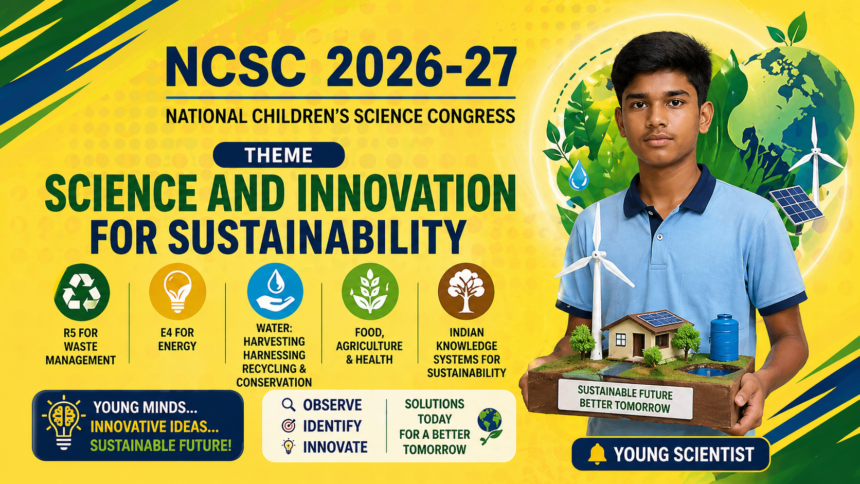
“Science and Innovation for Sustainability”
This theme reflects one of the most urgent needs of our time. It focuses on:
- Balanced use of natural resources
- Environmental protection
- Ensuring a sustainable future for upcoming generations
Sustainability means meeting present needs without compromising the ability of future generations to meet their own needs.
Importance of Mission LiFE
The theme aligns with India’s Mission LiFE (Lifestyle for Environment) initiative.
Objectives of Mission LiFE:
- Promote environmentally responsible behavior
- Encourage sustainable lifestyle choices
- Build harmony between humans and nature
Examples of Sustainable Practices:
- Reducing plastic usage
- Saving electricity
- Conserving water
- Using public transport or bicycles
Mission LiFE emphasizes that small individual actions can collectively create a large global impact.
Current Environmental Challenges
According to the guidebook, Earth is facing several critical issues:
- Deforestation
- Pollution
- Climate change
- Melting glaciers
- Rising sea levels
These warning signs highlight the urgent need for immediate action.
Sub-Themes of NCSC 2026–27
1. R5 for Waste Management
(Reduce, Reuse, Retrieve, Redesign, Recycle)
Waste management has become a major global concern. A large portion of waste generated is not properly processed.
The R5 Principles:
1. Reduce
Minimize consumption and avoid unnecessary use of materials.
2. Reuse
Use items multiple times instead of discarding them.
3. Retrieve
Recover useful materials or energy from waste.
4. Redesign
Develop products that generate less waste and last longer.
5. Recycle
Convert waste materials into new usable products.
Example Project: E-Waste Management
Electronic waste contains valuable metals such as:
- Gold
- Copper
- Lithium
Benefits:
- Reduces environmental pollution
- Saves natural resources
- Supports economic growth
2. E4 for Energy
(Explore, Experiment, Enhance, Evolve)
Energy is essential for modern life, but traditional sources like fossil fuels harm the environment.
E4 Model:
1. Explore
Understand different forms of energy.
2. Experiment
Conduct practical experiments like solar cookers or windmills.
3. Enhance
Improve energy efficiency.
4. Evolve
Adopt sustainable and green technologies.
Examples:
- Solar panels
- LED vs traditional bulbs
- Biogas systems
3. Water Management
(Harvesting, Harnessing, Recycling, Conservation)
Water is essential for life, yet water scarcity is increasing globally.
Key Approaches:
1. Harvesting
Collect and store rainwater.
2. Harnessing
Use water efficiently.
3. Recycling
Reuse wastewater.
4. Conservation
Reduce water wastage.
Example Project: Water Audit
Steps:
- Measure daily water usage
- Identify wastage points
- Suggest conservation methods
Outcome:
- Awareness and reduction in water usage
4. Food, Agriculture & Health
Food is directly linked to human health.
Key Concepts:
- Organic farming
- Balanced nutrition
- Sustainable agriculture
Importance:
- Better health
- Environmental protection
- Soil conservation
Examples:
- Organic farming experiments
- Nutritional studies
5. Indian Knowledge Systems (IKS)
India’s traditional knowledge offers valuable insights into sustainable living.
Examples:
- Ayurveda
- Yoga
- Rainwater harvesting
- Traditional agriculture
Importance:
- Eco-friendly practices
- Cultural heritage
- Scientific relevance
Model Projects Explained
1. Composting
Process:
- Collect biodegradable waste
- Allow decomposition using microorganisms
Benefits:
- Produces organic fertilizer
- Reduces landfill waste
- Improves soil fertility
2. Wetland Filtration System
Process:
- Use aquatic plants to purify wastewater
Benefits:
- Natural purification
- Cost-effective
- Eco-friendly
How to Conduct a Research Project
Steps:
- Identify a problem
- Form a hypothesis
- Collect data
- Analyze results
- Draw conclusions
How to Present a Project
- Speak clearly and confidently
- Use charts, graphs, and models
- Present data logically
- Answer questions effectively
Role of Students
Students are future scientists and innovators.
Their Role Includes:
- Creating awareness
- Developing solutions
- Inspiring communities
Conclusion
The National Children’s Science Congress is not just a competition—it is a movement that nurtures scientific thinking, innovation, and responsibility among children.
The theme “Science and Innovation for Sustainability” is highly relevant in today’s world. If young minds adopt sustainable practices now, they can ensure a safer and healthier future.
Final Message
👉 Every child is a scientist
👉 Every problem is an opportunity
👉 Every solution can change the future